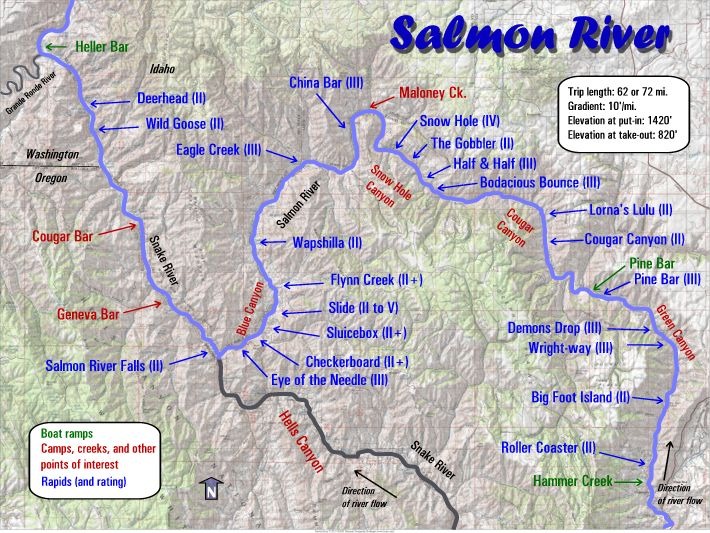

The Lower Salmon is separated from what is commonly
called the Main Salmon by Carey Falls, about twenty miles upstream from
Riggins. Roads parallel the river throughout the stretch from Carey
Falls to White Bird, so this stretch doesn’t lend itself to wilderness
river trips. Our trips begin at either Hammer Creek or Pine Bar, a short
distance downstream from White Bird.
From White Bird, the Salmon River winds northwest to
Horseshoe Bend, where it makes a 180 degree turn before winding in a
generally southwesterly direction to its confluence with the Snake
River. The Snake flows north-northwest to slack water backed up by the
Lower Granite Dam near Lewiston, Idaho. Our trip ends at Heller Bar,
about 25 miles south of Lewiston.
The oldest rocks here, called "basement" rocks by
geologists, date from the early Mesozoic period, and are more than 200
million years old. Indications are that these rocks have been
transported from the southwest Pacific area. Rocks include an array of
ocean floor sediments and volcanics. Most have been subject to a low
degree of heat and pressure, and as a result, display distinct signs of
alteration, or metamorphism.
The widely accepted theory of plate tectonics suggests
that these rock structures collided with North America during the middle
Mesozoic period, after being carried across the Pacific Basin by a
process related to continental drift. Fossils here are altogether
different from those of the same age found nearby in Nevada and Utah.
Rock masses of this type, which have been transported by the movement of
the Earth’s crustal plates, are referred to as "exotic terranes."
Typically, they are completely different from the local or "country"
rocks and are confined to separate areas of exposure. There is growing
evidence that the foundation or "basement" bedrock over much of eastern
Oregon and western Idaho may have been formed elsewhere, then was
transported to North America.
The metamorphic process of heat and pressure has
distorted and altered this rock, which originally formed as sedimentary
deposits, eradicating many of its original structures; but some
features, including fossils,
are occasionally visible. Most of the fossils are of
oceanic animals from ancient continental shelf environments. These are
mainly of mollusks, but recently fossils of large marine reptiles have
been discovered.
The overlying rock series in the geological "layer cake"
of the Salmon River Canyon are lava flows, which were erupted during the
Miocene period, 15 million years ago. These lava flows are part of the
Columbia River Basalt flows that are visible over much of eastern Oregon
and Washington as well as in central and southern Idaho. During these
many volcanic episodes, very fluid lava flowed like syrup over wide
areas of the landscape from low volcanic cones and fissures or cracks.
Remarkably, although these flows cover hundreds of square miles to
depths of thousands of feet, no exact source has been located.
In the period just prior to these lava eruptions, a
spectacular, rugged topography had been eroded into the existing older
terrain. This erosional surface is estimated to have measured as much as
4,500 feet from the canyon bottoms to the crests of the divides. Careful
mapping of this ancient surface shows that streams in the Salmon area
roughly paralleled their present patterns. The flood-like lava flows
inundated the valley system, covering all but the highest peaks with
layer upon layer of hard black columnar basalt. After the eruptions, the
Clearwater embayment, including the Salmon, was a flat expanse of
cooling lava with island-like buttes projecting here and there above the
lava plain.
Lava eruptions were not continuous. Between major
eruptions and flows, vast inland lakes developed and slowly filled with
volcanic mud, ash and dust. These lake sediments, referred to as the
Latah Formation, are situated at several levels within the lava flows
and bear the distinctive fossilized leaves of Miocene flora. Near White
Bird, Idaho, exposures of Latah sediments are famous for their
beautifully preserved deciduous (hardwood) leaves, quite different from
the local coniferous forests of today.
The geologic map of the Salmon region shows alternating
exposures of basement rock along the river. This patchiness is due to
the roughness of the underlying topography. As the river erodes through
the lavas, it first exposes the old basement "highs" that were divides
before the lava covered them. Two such divides parallel the present
Salmon in its last thirty-nine miles before meeting the Snake River.
Very young, unconsolidated sands and gravels of the
river system, as well as a layer of very fine dust known as the Palouse
Formation overlie the lake sediments (Latah Formations) and basalt
layers in the Salmon River drainage. The Palouse is a powdery,
buff-colored, wind blown dune deposit (loess). This partially
consolidated deposit is very thick in the vicinity of southeastern
Washington. As it decomposes, it forms the foundation for the rich
Palouse soil that is the basis for eastern Washington’s soft wheat
industry.
Along the river between White Bird and Heller Bar, gold
has turned up several times, but no large strikes occurred. This gold
occurs in trace amounts along the entire length of the Salmon, with very
scattered richer pockets. As a rule, the gold is very fine, almost like
flour.
Salmon Geology at River Level
The Salmon from White Bird to the Snake does not
directly cut across the Idaho Batholith, however, exposures of granites
are only a few miles away to the east. Consequently, much of the river
gravel is composed of quartz-rich, gray to white crystalline granites.
Many north-south faults occur in the canyons north of
White Bird. In places, the river has followed these breaks in the rock
in straight lines for many miles before meandering away. The faults are
visible in the canyon walls as smooth, striated surfaces that reflect
the sun like polished metal. Along the old faulted surfaces,
mineralization is evident where stains discolor the rocks.
Just north of White Bird, the river cuts into the top of
an old divide, below the skyline lavas. 200 million year-old (Triassic)
rocks in this twelve mile stretch bear a distinctive, dark greenish hue,
due to characteristic heat treated minerals (metamorphic rock).
Metamorphic rocks are typically very hard, and one
effect of this is the formation of narrow canyons. Constriction of the
river channel causes the stream's velocity and erosional power to
increase substantially.
Erosion of these rocks causes curious textures. One of
the more striking of these is a fluting or sand-blasted effect. Sand,
borne in the water, cuts long, finger-size grooves or flutes parallel to
the direction of stream flow. The rocks are often incredibly smooth to
the touch where the water and sand have polished the surface. Near the
water line, the rocks receive a final patina of "desert varnish" or a
jet black color due to exposure alternating from wet to very dry and
hot.
A short section of basalt just before the confluence
with the Snake River is an example of an old stream channel now filled
with lava.
In the stretch of lower Hell’s Canyon between the mouth
of the Salmon River and Heller Bar, several good examples of basement
rock can be seen. Just a few miles south of Heller Bar, limestone
appears on both sides of the river. These limestone deposits are cooked
in places to form the metamorphic rock, marble. The limestone is folded
up and lying nearly on its edge, which creates a very sharp series of
ridges.